Foreclosed Homes in Upstate New York: How the Process Works and Where to Look
You can find foreclosed and bank-owned homes in upstate New York through online platforms such as Vihara, court-ordered referee sales, county tax auctions, government sites (HUD Home Store, Fannie Mae HomePath) and local agents. Every New York mortgage foreclosure is a court case in the state Supreme Court, and every step waits on the court's calendar. So many upstate foreclosures reach buyers as bank-owned homes, after the case is over.

Where can I find foreclosed homes in upstate New York?
Five places, each at a different point in the process:
| Where | What you'll find | Who it suits |
|---|---|---|
| Online platforms such as Vihara | Bank-owned and distressed homes, each with a starting price and an estimate | Buyers comparing deals side by side |
| Referee foreclosure sales | Homes sold at the court-ordered auction, at the time and place in the notice of sale | Experienced buyers ready to pay on the referee's terms |
| County tax foreclosure auctions | Homes the county took for unpaid property taxes | Investors who expect to fix a lot |
| HUD Home Store and Fannie Mae HomePath | Homes owned by HUD or Fannie Mae after a foreclosure | Owner-occupants and first-time buyers |
| Local agents | Bank-owned homes on the open market | Buyers who want someone local to look at the house |
Homes upstate generally cost less than homes in and around New York City, which is why buyers look in the North Country, the Southern Tier and around Syracuse, Rochester and Buffalo.
Which upstate New York properties are on Vihara right now?
As of 14 November 2026, there's one:
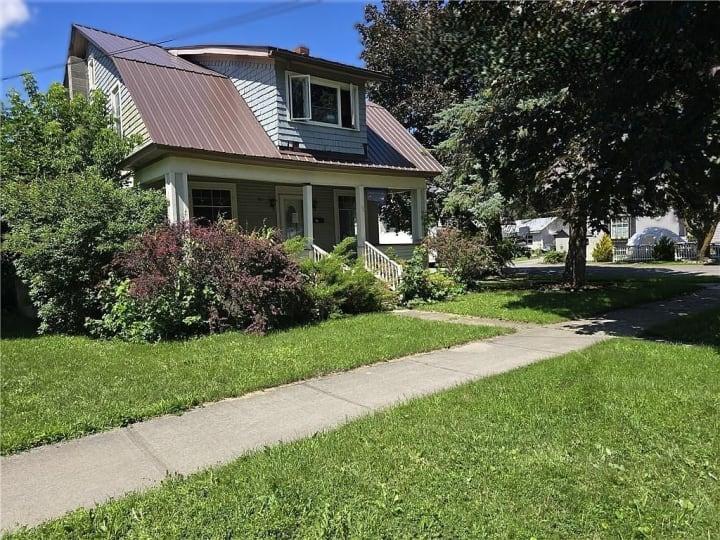
- 401 Rensselaer Ave, Ogdensburg, NY 13669: 3 beds, 1.5 baths, about 2,048 sq ft
Ogdensburg is a small city in St. Lawrence County, on the St. Lawrence River. Starting price, estimate and photos are on the property page. See the Ogdensburg deal.
How does the foreclosure process work in New York?
Every New York mortgage foreclosure is a lawsuit. For most owner-occupied homes, here's the order:
- The 90-day notice. At least 90 days before filing, the lender must send the borrower a notice with a list of at least five housing counseling agencies serving the county.
- Summons and complaint. The lender files the case in the Supreme Court of the county where the home is. (In New York, the Supreme Court is the main trial court, not the top court.)
- The settlement conference. When the borrower lives in the home, the court must hold a settlement conference within 60 days, to look for another way out, such as a loan modification.
- Judgment of foreclosure and sale. If the case isn't settled or won by the owner, the court orders the home sold, usually by a referee it appoints.
- Notice of sale. The sale is published in a newspaper once a week for four weeks in a row (or twice a week for three weeks).
- The referee's sale. The referee auctions the home at the time and place in the notice. The lender often bids what it's owed.
- The deed. The officer who ran the sale signs a deed to the winning bidder.
Why do New York foreclosures take so long?
Because every step runs on a court's calendar. The 90-day notice, the settlement conferences, the motions and the judgment all come before a sale date is even set. If the owner contests the case, add more.
That's why New York is known as a slow foreclosure state. For a buyer, it means two things. The home may have been empty a long time. And by the time a bank owns it, the legal part is finally done.
Is there a redemption period after a New York foreclosure?
No. Before the sale, the owner can still pay and stop it. After the sale, New York law says the deed is "an entire bar" against the parties to the case, so there's no window to buy the home back.
Some other states do give owners time after the sale. That's one reason the details of each state matter so much.
What are "zombie" homes in New York, and why should a buyer care?
A zombie home is one the owner has left while the foreclosure grinds on, so nobody is looking after it. Since 2016, New York law has required the servicer and the lender on a vacant, abandoned one-to-four-family home in default to inspect it, secure it and maintain it.
That helps, but it doesn't heat the house. A home that sat empty through an upstate winter can hide burst pipes, a cracked boiler, roof leaks and mold. Price it as if you'll find at least one of those, and be pleasantly surprised if you don't.
What should I check before buying a foreclosure upstate?
Here's what to check, and where:
| Check | Where to look | Why it matters |
|---|---|---|
| Winterization | Ask the seller; look for tags on the panel and the fixtures | Tells you whether the plumbing was drained before the cold |
| Heating system and fuel | Your inspector; look for an oil or propane tank | Many upstate homes heat with oil or propane, and an old boiler is a big line item |
| Title and liens | A title company or real estate attorney (deeds are recorded with the county clerk) | Some debts survive the sale |
| Property and school taxes | The city or town assessor and the county treasurer | Taxes are part of what you carry every month you own it |
| Code violations | The city or town code office | Older homes in small cities often carry open orders |
| Occupancy | Drive by; ask the seller | New York's legal process applies before you can take possession |
| Lead paint | Your inspector | Sellers of homes built before 1978 must disclose known lead paint; sales at the foreclosure itself are exempt |
In New York, an attorney usually handles each side of a home closing. Bring yours in early. They'll read the title report and the referee's or bank's terms with you.
Can I get a STAR tax credit on a foreclosed home I'll live in?
Possibly. STAR is New York's school tax relief program, and new homeowners register for the STAR credit with the state tax department once the home is their primary residence. Income limits apply. It's worth checking if you're buying to live in, not to rent.
Should I buy at a referee's sale or buy bank-owned?
At a referee's sale, you buy as-is, usually without seeing inside, and you pay on the referee's terms. It suits a buyer with cash, an attorney on call and a contractor who likes surprises.
A bank-owned home has already been through the court case. You can usually walk through it, bring an inspector, and close on a normal schedule. For most buyers, especially first-timers, that's the easier road. What a bank-owned home is.
Financing is available through Vihara's financing partners. Talk to a Vihara advisor about the Ogdensburg home or anything else in New York, at no cost.
Frequently asked questions
How long does foreclosure take in New York?
Often a long time. Every foreclosure is a court case, each step waits on the court's calendar, and a contested case takes longer.
Who runs a foreclosure auction in New York?
Usually a referee appointed by the court, sometimes the sheriff. Whoever runs the sale signs the deed to the winning bidder.
Can the owner get the home back after a New York foreclosure sale?
No. The owner can pay before the sale, but after it, New York law makes the deed an entire bar against the parties to the case.
Where are foreclosure auctions held in St. Lawrence County?
Referee sales are published in a newspaper, and the notice gives the time and place. County tax auctions are run by the county. Bank-owned homes, like Vihara's Ogdensburg property, are bought without going to an auction at all.
Are foreclosed homes cheaper in upstate New York?
Often. Homes upstate generally cost less than homes around New York City, and foreclosed homes are sold as-is, so they can be priced below similar homes nearby. Budget for repairs, especially on a home that sat empty through a winter.
Sources
- 01New York Real Property Actions and Proceedings Law, section 1304 (90-day notice)
- 02New York Civil Practice Law and Rules, section 3408 (settlement conferences)
- 03New York Real Property Actions and Proceedings Law, section 231 (notice of sale)
- 04New York Real Property Actions and Proceedings Law, section 1353 (the deed after the sale)
- 05New York Real Property Actions and Proceedings Law, section 1308 (vacant and abandoned property)
- 06New York State Department of Financial Services, vacant and abandoned ("zombie") property
- 07New York State Department of Taxation and Finance, "Register for School Tax Relief (STAR)"
- 08US EPA, "Real Estate Disclosures about Potential Lead Hazards"
- 09HUD Home Store
- 10Vihara properties, retrieved 14 Nov 2026
Trisha co-founded Vihara in 2022 to bring bank-owned and distressed property auctions online. Before Vihara, Trisha was a product manager at Abbott Laboratories and Hill Physicians Medical Group, and holds an MS in Public Health from the University of Pennsylvania.
LinkedIn ›

